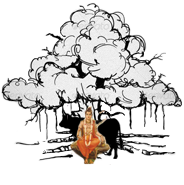
Sadguru Kripa
In September 1931 he went to forester Rama Rao's home at Holalkere at the bidding of Dummi Nanjundappa. There he saw Sri Dattaraja Yogindra. At first he saw Suryamandala (Suns' disc) and in its center Dattatreya. He remembered Shankara Bhagavan's words and tears of gratitude filled his eyes. His Guru had fulfilled his promise. After sometime he could see Sri Dattaraja Yogindra. He worshipped his feet with jasmine flowers and sat at his feet like Hanuman at the feet of Lord SriRamachandra. Yogindra said, "My work is over." Ranganna who was experiencing Brahmananda had a shade of doubt whether it was Brahmanubhava. A Guru has to testify it. Yogindra said, "It is Brahmanubhava".
Dattaraja Yogindra was born at Banavasi (Uttara Kannada). At a young age he experienced thurya. People mistook it for madness. His parents celebrated his marriage but instead of living as a householder. He went to meet great saints like Yerritata of Chelugurki, Lakshmamma of Adavani and Siddharudha of Hubli. At his bidding he was a grihastha until he begot a son and then Sri Sahajananda came tested him and passed on all the accumulated thaposhakti with him. After Mahasamadhi of Sahajananda Yogindra traveled all over the state and his meeting of Ranganna immensely benefited the world.
Ranganna took part in about four Aradhana Saptahas of Sahajananda.
In 1932 the marriage of Rangappa's daughter was celebrated with the son of Lokikere Srinivasa Rao was a very rich person but his leanings were always with Adhyatma. He had practiced yoga and had met many Gurus but his mind was full of unrest. After the marriage, Ranganna went to Malenahalli with Srinivasa Rao and Shankarappa his own brother. After the arathi they sat in the temple. Rangappa told them:
"This world is the creation of Iswara, who is master of all, omniscient, omnipotent and Antaryami (he who controls from within). Innumerable universes originate from him, live in him and go to him after their time is over. His true nature is not known to Jeevis, and so they become addicted to " I" and "mine". This can be done in Nirguna and Saguna ways.
Love Paramatma and develop the following attitude "Let my hands do your work, Let the feet walk to serve you. Let my eyes see your form, let my ears hear your glory. Let my head fall on your feet. Let my mind be dissolved in you. Offer the fruits of all your deeds to him. If this feelings becomes constant, He will manifest himself before you as your Guru"
Hearing this Srinivasa Rao thought, "I think Ranganna is the Guru, whom I was searching for all these days.
Rangappa went to Honnali where his brother Shankarappa was a teacher. During evenings Shankarappa would read Bharatha and Rangappa would interpret it. Those who heard Rangappa's interpretation though that he was a great Sanskrit scholar. Really he attended the local school and learnt writing on sand.
Once when Rangappa interpreted Lord Krishna's visit to Vidura's home, Bhimachar an erudite dwaitha scholar and archak of Sri Raghavendraswamy Brindavan at Honnali broke into tears. When Rangappa asked for the cause of his behavior he said "Ranganna, today you made me to see Krishna and Vidura. But you stressed Advaitha." Rangappa said, "I am not talking about dwaitha or advaitha. The words in the poem are "eradudarada gadha bhakti". The poet has written it from the stand of Parabhakti. In its peak form Bhakti does not retain two entities. Bhagawan and Bhaktha become one."
After a long discussion Bhimachar was convinced about the greatness of Rangappa and he used to say, "Rangappa is an incarnation of Maharudra". He took initiation from Rangappa but never made it public.
From Honnali Rangappa went to Komaranahalli and worshipped Sri Ranganatha there. He went to Harihara, offered fruits to Sri Harihareshwara there and returned to Nulenur.
Later, Shankaralinga used to say, "When I was on my way to Honnali Ananda gushed upwards." This is the state of Anandini. There are seven stages in a Sadhaka's journey towards self-realization. They are (1) Determination to achieve Brahmananda (2) Atma-Vichara-meaning a systematic enquiry about who one is according to upanishadic logic (3) Nissanga meaning the realization that atman has nothing to do with external world, body and mind. (4) Vasanakshaya: which is real Sadhana. Due to innumerable lives and deaths a Jeevi is attached to three things. First is dehavasana-concerning his body. Second is Sastra vasana concerning the studies he has conducted in order to known which path he has to follow. (3) LOKAVASANA whichever path he may pursue he has to follow the one and the only one path, which leads him to self-realization.
Nanyahpantha Ayanaaya Vidyathe. That is to approach the right Guru and know the meaning of Tat-twam-asi. These four are called Sadhana bhoomikas. The fifth is Anandini, Sixth Turya and the seventh is Thuryathitha.